
12 August 2026
Nanyang academy of fine arts
Nanyang academy of fine arts









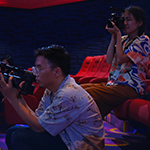



Presentation12 August 2026, 11:20am to 11:35am
Dialogue 12 August 2026, 02:55pm to 04:15pm
This presentation will reflect on collaborative research methodologies, drawing from a coauthored, in-progress book manuscript on Southeast Asian film collectives, coauthored with Dr. Philippa Lovatt and titled Practices of Futurity. The book is grounded in our work on the organizing committee of the Association for Southeast Asian Cinemas. Drawing from oral histories, site visits, and close readings of films, we focus on four groups: Forum Lenteng (Jakarta, Indonesia; 2003-present); Los Otros (Quezon City, Philippines; 2003-present; Hanoi DocLab (2009-2019); and Anti-Archive (Phnom Penh, Cambodia, 2014-present).
As the presentation will discuss, Practices of Futurity redefines film practice to include production, aesthetic experimentation, pedagogy, translation, and, in a reflexive gesture towards feminist methodologies, the work of research itself. We see film practice is an embodied, affective form of interrelational labor, inextricable from material environments. Through the process of collaboration, the book seeks to collectively reimagine what research could be if reoriented toward vulnerability, rather than mastery. Its analysis of film practice gives attention to the transformative potentials of collective imagination and labor in the arts groups we engage. Woven throughout is another story of how these film collectives have transformed the ways we think of our own work as writers, teachers, and organizers. Ultimately, the book asks: how can we make and sustain creative worlds, as the worlds we know collapse and reshape around us?
Drawing from this project, the presentation will consider neurodiversity as a lens for considering how to transform academic arts research.


Jasmine Nadua Trice is an Associate Professor of Cinema and Media Studies in the Department of Film, Television, and Digital Media. Her first book, City of Screens: Imagining Audiences in Manila's Alternative Film Culture (Duke University Press, 2021) examines the politics of cinema circulation in early-2000s Manila, Philippines, a moment of profound technological and industrial transition. Employing theories of public culture, urban studies and Philippine cultural studies, the book traces Manila's post-millennial cinema landscape by focusing on the primary locations of film exhibition and distribution: the pirated DVD district, mall multiplexes, art-house cinemas, the university film institute and state-sponsored cinematheques. In the wake of digital media piracy and the decline of the local commercial film industry, the rising independent cinema movement had been a site of contestation between filmmakers and the state, each constructing different notions of a prospective, national public film audience. The book includes a digital companion site, which maps a selection of shooting sites and exhibition spaces throughout Manila.
Trice is currently working on a second book on film organizing in Southeast Asia, co-authored with Dr. Philippa Lovatt of the University of St. Andrews, Scotland. This book grew out of a curatorial project undertaken between 2016 to 2018, in collaboration with the Association for Southeast Asian Cinemas (ASEAC). Trice was co-investigator of a four-country research network funded through the Arts and Humanities Research Council (U.K.), the Southeast Asian Cinemas Research Network: Promoting Dialogue Across Critical and Creative Practice. The network aimed to create spaces for the exchange of ideas among scholars, students, filmmakers, curators, archivists and the general public. As a means of continuing this project and its commitments to public-facing film research, Trice has created an online portal to share oral histories of film practice in Southeast Asia.